


Building a home in Kerala? Let’s start with a conversation.
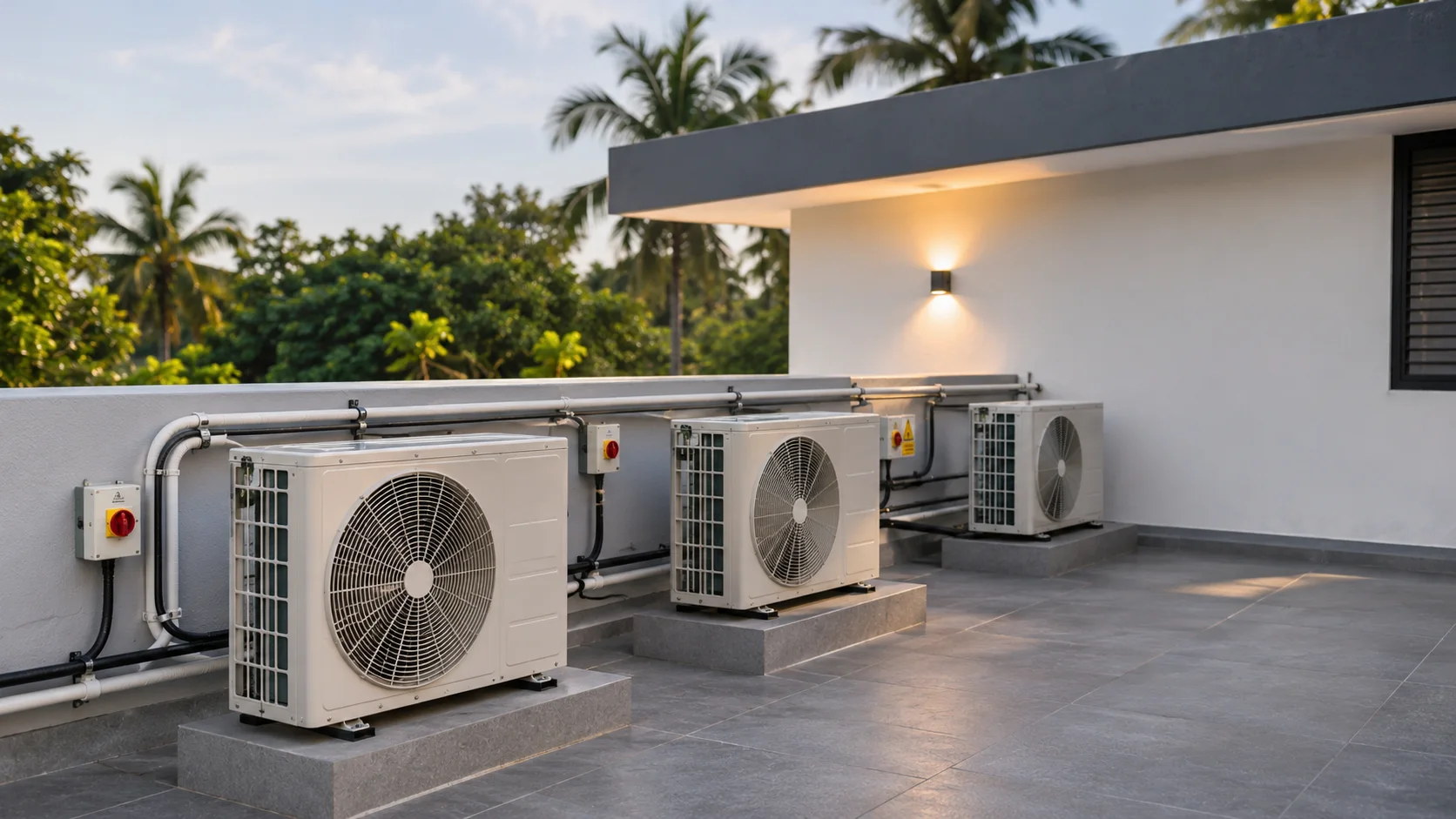
What size AC does your room need?
Room size, the wall that takes the sun, the roof above and the people inside give the tonnage, the star rating to pick and where to fit the indoor unit.
In Kerala, plan about 1 ton of AC for every 120 to 150 sq ft; a 12 × 12 ft bedroom usually needs 1 to 1.5 ton. West-facing rooms, top floors under a bare slab, large windows and more people need more.
Rates and rules last updated 17 November 2026 · Checked by the Build 1 engineering team
Your room
What it is used for and how big it is.
144 sq ft · about 13 sq m
Sun and roof
Which wall takes the sun, and what is above.
Inside the room
People, appliances and how long it runs.
Bedroom, 144 sq ft · about 19,008 BTU an hour (1.6 ton)
Where the heat comes from
1 ton of cooling removes 12,000 BTU an hour. Rooms that face west or sit under a bare roof need the most.
Your room
Sunny wall or big window (west)
Indoor unit: on the opposite wall, blowing across the room toward the heat, and not over the bed.
Units a year by star rating
For 8 hours a day over 8 months, about 1,946 hours a year. At ₹7 a unit the gap between 3 and 5 star is about ₹1,800 a year.
Before you buy
- Choose an inverter AC: it slows down instead of switching off and on, which saves power and keeps the room steady.
- Run a separate 16 A or 20 A circuit with its own MCB for each AC. Plan the point, the drain pipe and the outdoor unit spot before plastering.
- Set it at 24°C to 26°C with the ceiling fan on low: each degree warmer saves about 6% of the power.
- A bare roof slab adds a lot of heat. Heat-reflective paint, a false ceiling or a sloped sheet roof above the slab cuts the load and the AC size.
- Shade the west window with a sunshade (chajja), outside blinds or plants; heat stopped outside never reaches the AC.
Figures last updated 17 November 2026. A rule-of-thumb estimate; a heat-load calculation by an HVAC engineer is more exact for large or glass-heavy rooms.
No black box. Here is the logic.
Reviewed on 17 November 2026. The numbers are in the table further down.
Heat load
- Base: room area × 80 BTU per sq ft (about 1 ton per 150 sq ft in Kerala), scaled for ceiling height.
- Plus sun on the walls and windows, roof heat on a top floor, 600 BTU per person beyond two, appliances and an open kitchen.
- Plus 10% for Kerala humidity.
Tonnage
- Tons = BTU an hour ÷ 12,000.
- Rounded up to the next split AC size: 0.75, 1, 1.5, 2, 2.5 or 3 ton.
Star rating
- Yearly units = capacity × hours × average load ÷ ISEER.
- More hours a year make a 5-star pay back sooner.
Limits
- A rule of thumb, good for normal rooms.
- Large glass rooms and commercial spaces need a proper heat-load calculation.
Every number is on this page, and dated.
Last updated 17 November 2026. Load factors are common Indian sizing rules of thumb; BEE star levels changed in January 2026, and sources differ on the exact thresholds.
General
Click a number in the editor to change it, then press Save.
17 November 2026
80 BTU
0.9
10 %
Sun on the walls
Added to the base load for the wall that gets the most sun or has the biggest window.
-5 %
0 %
5 %
8 %
10 %
18 %
20 %
10 %
0 %
5 %
12 %
10 %
Roof, people and appliances
25 %
12 %
600 BTU
150 W
250 W
150 W
4,000 BTU
Star ratings (BEE, from January 2026)
Split AC ISEER used for the yearly units. Check the label: sources differ on the exact 5-star threshold.
4.5
5.2
5.7
0.55
700 hours
1,200 hours
7 ₹
To change a number: open the site editor, click the number, type the new value and press Save. The tool uses it straight away.
Get the house AC-ready.
Most AC trouble comes from what was not planned before plastering.
Point and circuit
A 16 or 20 A point near each indoor unit, on its own MCB and circuit.
Pipe sleeve and drain
A sleeve through the wall and a drain route to a gully, not down the wall.
Outdoor unit spot
Shaded, ventilated, safe to service, and close to the indoor unit.
Cut the heat
Sunshades, roof insulation and light colours shrink the AC you need. See the home systems planner.
Questions about AC sizing.
How many tons of AC do I need?
As a start, about 1 ton for every 120 to 150 sq ft in Kerala. A 12 × 12 ft bedroom usually needs 1 to 1.5 ton. A west-facing room, a top floor under a bare slab, big windows or more people push it up, which the tool adds one by one.
What does 1 ton mean?
One ton of cooling removes 12,000 BTU of heat an hour, about 3.5 kW of cooling. It has nothing to do with weight.
Is a bigger AC better?
Not with a fixed-speed AC: it cools fast, switches off, and leaves the room damp. An inverter AC handles a little extra size well because it slows down, so if your room falls between sizes, an inverter of the next size up is fine.
3 star or 5 star?
It depends on hours of use. A 5-star AC uses about a fifth less power than a 3-star, so it pays back fastest in a bedroom used every night through the hot months. For a room used a few hours a week, a 3-star inverter is enough. BEE made the star levels stricter from January 2026, so check the ISEER number on the label.
Does Kerala's humidity matter?
Yes. In Kerala the AC also has to take moisture out of the air, which takes extra capacity. The tool adds about 10% for it. Dry mode on the AC helps on muggy monsoon days.
What should be ready before the AC is fixed?
A separate 16 A or 20 A circuit with its own MCB, a power point near the indoor unit, a sleeve through the wall for the pipes, a drain route for the water and a safe, shaded place for the outdoor unit. All of these are easier before plastering.
Where should the indoor unit go?
On a wall where the air can blow across the room toward the sunny wall or window, not straight onto the bed, and at least 15 cm below the ceiling. Keep the outdoor unit close by, in the shade and with room for air to flow.
How current are the numbers?
The date at the top shows when the figures were reviewed. Star rating levels and power prices change, so every number is in the table on this page and can be updated.
Let’s plan your cooling.
Every good project starts with a clear conversation. Share your plot, approximate area, requirements and budget range, and we’ll suggest the right route and package.
Free site visit and plot check
Anywhere in Thrissur and Ernakulam districts.
Your price in writing in 7 days
Itemised, within 7 days of the site visit.
See a live site on a Saturday
Walk a Build 1 site with our engineer.