


Building a home in Kerala? Let’s start with a conversation.
How much rain can your roof save?
Pick your district and roof. See the litres collected each year, the tank you need for the dry months, the building rule minimum and how the system fits together.
Each square metre of roof collects about one litre of water for every millimetre of rain, less first-flush losses. A 1,200 sq ft roof in Thrissur, with about 3,000 mm of rain a year, can collect close to 2.5 lakh litres.
Rates and rules last updated 17 November 2026 · Checked by the Build 1 engineering team
Your roof
Where you are and how much roof drains to the tank.
About 111 sq m
Your water use
Who uses it and for what.
About 280 litres a day from rain.
For the building rule
Floors and plot, to check the minimum storage.
111 sq m of roof in Thrissur · about 3,000 mm of rain a year
Rain collected and water used, month by month
Most rain falls from June to October. The dry months, usually December to April, decide how big the tank must be.
Water in your tank through the year
Water left at the end of each month. The tank stays full through the monsoon and runs down in the dry months; where it touches zero you need the well or mains.
Bigger tank, more of your need met
Each step up in tank size helps less. The marked point is the smallest tank that reaches your target.
What the system needs
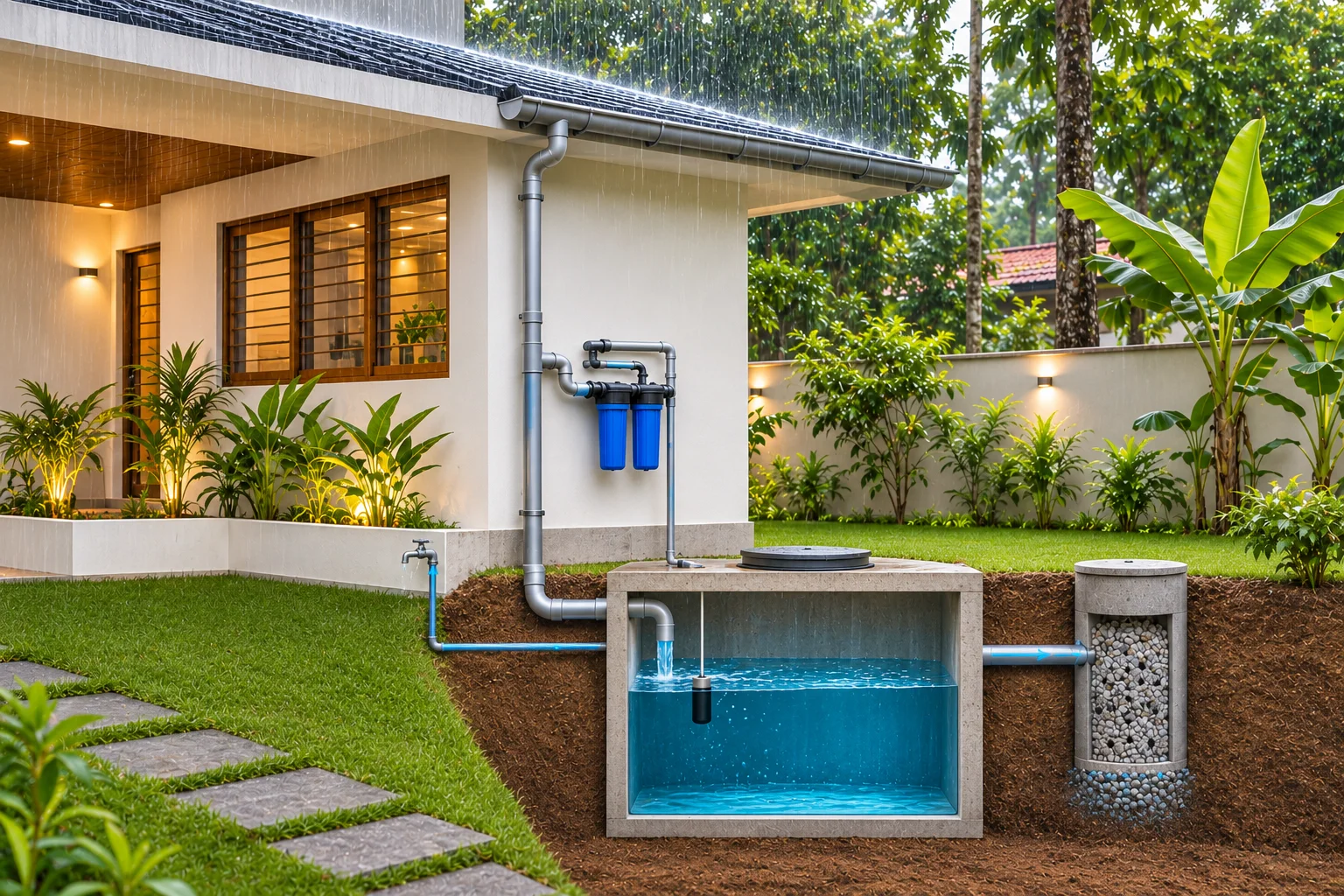
Holds the first 111 litres of each shower, which washes dust and leaves off the roof.
A sand, charcoal and pebble filter, or a mesh filter, before the tank.
About 3 downpipes of 75 to 110 mm for this roof, each with a leaf trap at the top.
Lead overflow to an open well or a recharge pit, never to the septic tank or a neighbour’s plot.
The building rule
A single-family house up to 150 sq m of total floor area on a plot up to 320 sq m does not have to provide rainwater storage. It is still worth it. Check the current rule with your local body before you apply for the permit.
Figures last updated 17 November 2026. Rainfall is a long-term average; any one year can be far wetter or drier.
No black box. Here is the logic.
Reviewed on 17 November 2026. The numbers are in the table further down.
Rain collected
- Litres = roof area in sq m × rain in mm × runoff.
- Less a first flush of about 1 mm on each rainy day, and about 10% at the filter.
- Spread over the months with a district rain pattern.
Tank size
- Month by month the tank fills with rain and drains with your use.
- The tool tests sizes from 1,000 to 1 lakh litres and picks the smallest that meets your target.
Building rule
- Kerala rules: at least 25 L per sq m of total floor area for houses.
- Exempt: single-family houses up to 150 sq m on plots up to 320 sq m.
The system
- Gutters, downpipes with leaf traps, a first-flush pipe, a filter, the tank and an overflow to recharge.
Every number is on this page, and dated.
Last updated 17 November 2026. District rainfall is an approximate long-term average and needs checking against IMD normals; one year can be far wetter or drier.
General
Click a number in the editor to change it, then press Save.
17 November 2026
Rainfall, a normal year
Approximate long-term annual rainfall by district. Check against IMD normals for your area; hill and coastal spots differ a lot.
1,830 mm
2,450 mm
2,950 mm
2,700 mm
3,050 mm
3,300 mm
3,250 mm
3,000 mm
2,300 mm
2,900 mm
3,350 mm
3,000 mm
3,400 mm
3,550 mm
Rain through the year
Share of the year’s rain in each month, January to December.
1, 2, 3, 6, 10, 18, 14, 10, 8, 14, 10, 4 %
1, 1, 2, 4, 8, 22, 21, 14, 8, 11, 6, 2 %
0, 0, 1, 2, 6, 26, 28, 17, 8, 8, 3, 1 %
125 days
Roof and losses
How much of the rain reaches the tank.
0.8
0.75
0.9
0.78
1 mm
90 %
50 sq m
Water use
Litres a day for each person, by what the rainwater is used for.
10 L
70 L
135 L
150 L
Building rule
Kerala Panchayat and Municipality Building Rules, residential (Group A1).
25 L
150 sq m
320 sq m
To change a number: open the site editor, click the number, type the new value and press Save. The tool uses it straight away.
Four things to plan early.
Rainwater pipes and the tank are easy on paper and hard to add later.
Slope the roof to outlets
Give the slab a fall to the downpipe points and keep them away from the main door.
Fix the tank spot
A sump needs room for a pump, a lid you can open and a path for cleaning.
Plan the overflow
Lead it to the well or a recharge pit, sized with your engineer.
Show it in the permit
Draw the storage, filter and overflow on the plan so the permit and completion go smoothly.
Questions about rainwater harvesting.
How much rain can my roof collect?
Each square metre of roof collects one litre for every millimetre of rain, less what runs off or is thrown away in the first flush. A 1,200 sq ft roof in Thrissur, with about 3,000 mm of rain, can collect close to 2.5 lakh litres in a normal year.
What size tank do I need?
It depends on how much water you want from rain in the dry months. The tool runs your tank month by month, so it fills in the monsoon and drains from December to April, and picks the smallest tank that meets your target. Going bigger helps less and less, which the third chart shows.
Is rainwater storage compulsory in Kerala?
For most new buildings, yes. The building rules ask houses for storage of at least 25 litres per square metre of total floor area, with gutters, a first-flush pipe, a filter and a tank with overflow. Single-family houses up to 150 sq m of floor area on plots up to 320 sq m are exempt. Confirm the current rule with your local body.
Can I drink rainwater?
Rain from a clean roof, passed through a first-flush pipe and a filter, is good for most uses. For drinking, boil it or use a purifier, and keep the tank closed, dark and cleaned once a year.
What is a first-flush pipe?
A vertical pipe at the downpipe that fills with the first water of each shower, which carries dust, leaves and bird droppings. Once it is full, cleaner water flows on to the filter and tank. It empties through a small valve at the bottom.
What do I do with the overflow?
Send it to an open well or a recharge pit, so it refills the ground water you draw from in summer. Never lead it to the septic tank or a neighbour’s plot.
Underground sump or overhead tank?
Large tanks, from about 10,000 litres, are usually built as an underground RCC or ferrocement sump with a pump. Smaller ones can be ground-level plastic or ferrocement tanks. Plan the sump position, the pump and the overflow while the site plan is drawn.
How current are the numbers?
The date at the top shows when the figures were reviewed. Rainfall is a long-term average, and the district figures are approximate, so every number is in the table on this page and can be updated.

Let’s plan your water.
Every good project starts with a clear conversation. Share your plot, approximate area, requirements and budget range, and we’ll suggest the right route and package.
Free site visit and plot check
Anywhere in Thrissur and Ernakulam districts.
Your price in writing in 7 days
Itemised, within 7 days of the site visit.
See a live site on a Saturday
Walk a Build 1 site with our engineer.